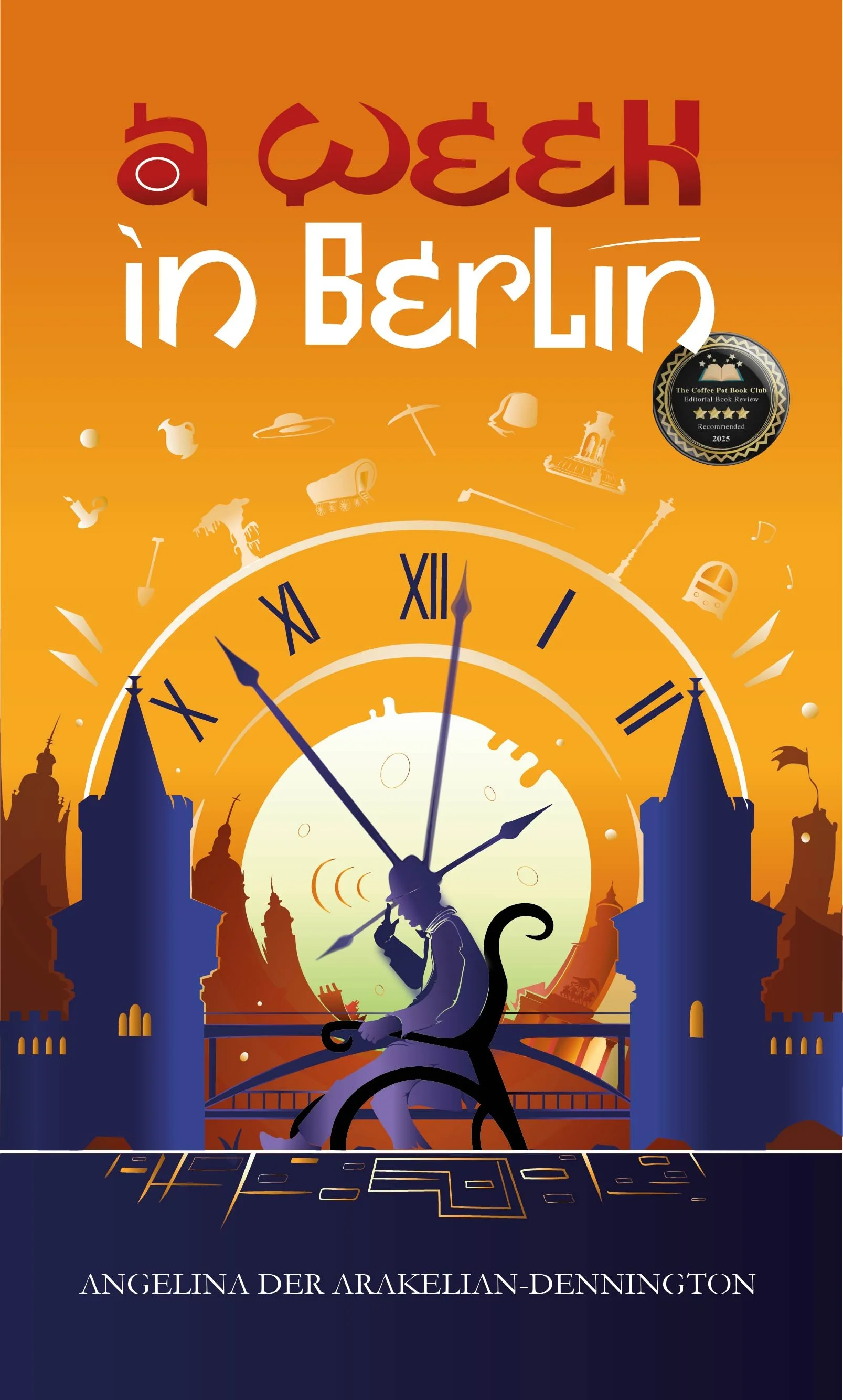
A Week in Berlin is a genre-bending, historical time-travel novel. It follows Badrig Serdzovian, an Armenian Genocide survivor who discovers the ability to travel through time and finds himself drawn to Berlin to confront his trauma and decide if he can rewrite history.
The Inspiration Behind the Story
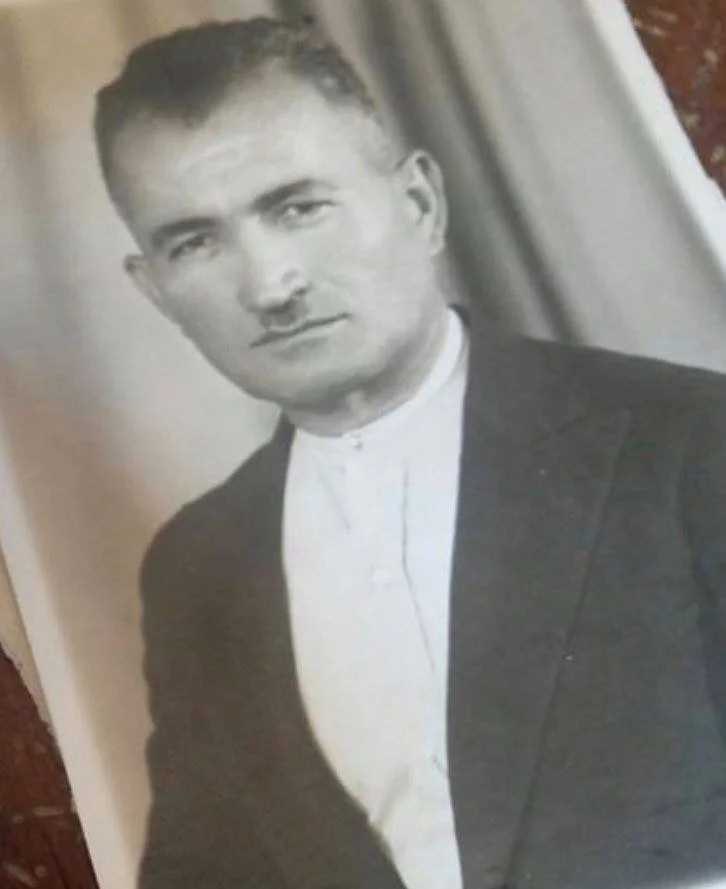
The idea for A Week in Berlin came to me when I started to contemplate my great-grandfather’s survival of the Armenian Genocide in 1915 – a story so improbable that it has always felt like both a miracle and a burden of fate. As the family story goes, he was lined up with other men to be executed by Ottoman troops when suddenly a carriage arrived. An officer called out several names from a list, but only my great-grandfather heard his own. He stepped forward, alone, and was pulled into the carriage. Moments later, as the carriage pulled away, he heard the gunfire behind him. One by one, the rest of the men who had remained were killed. That sound – the bullets ending the lives of those who had stood beside him – stayed with him for the rest of his life.
Later, he discovered that this miraculous intervention had not been random. One of the highest-ranking military heads of the Ottoman Empire had issued an order to save him. Why? Because my great-grandfather had once done excellent work repairing the officer’s carriage, and his skill and diligence had left such an impression that it ultimately saved his life.
I often reflect on that moment, on how close he came to death, and how my entire existence rests on a single decision, a single chance and a single voice that he alone heard. If he had not stepped forward, I would not be here. This realization has shaped not only my sense of identity but also my understanding of fate. It has taught me that history is not abstract but intimate, forming a part of who we are.
This personal connection to survival became the inspiration for my novel, which asks:
What role does fate play in the course of our lives? How much of who we are is shaped by choice, and how much by forces beyond our control? Can we bend time, or does time bend us? And in moments when history threatens to erase us, what ultimately defines our identity?
The Journey of Writing A Week in Berlin
The process of writing the book was as much an excavation as it was an act of creation. I began with a tape recording – an oral history passed down through my family – that recounted fragments of my great-grandfather’s experience. Translating that recording was my first step, as he spoke a language I don’t speak – Turkish – rather than what should have been his native tongue, Armenian. This was a process that brought me closer to his voice while also confronting me with the gaps and silences left behind.
From there, I immersed myself in research. I read survivor testimonies and studied historical records. I was filled with an intent to honor the truth of the past, while also creating characters who could carry this truth into a fictional world.
Building these characters, especially the main character who possesses traits of my great-grandfather, was an act of responsibility. I knew they had to embody the lived realities of displacement, survival, and love under impossible conditions. Each one had to carry purpose – not only within the narrative but also as a reflection of the countless untold stories that remain in the shadows of history.
And so, writing A Week in Berlin was layered with grief, discovery, and a deep sense of obligation. It was also an act of healing, because with each page, I found myself piecing together pieces of memory and shaping them into something that could live on beyond me.
Later, he discovered that this miraculous intervention had not been random. One of the highest-ranking military heads of the Ottoman Empire had issued an order to save him. Why? Because my great-grandfather had once done excellent work repairing the officer’s carriage, and his skill and diligence had left such an impression that it ultimately saved his life.
I often reflect on that moment, on how close he came to death, and how my entire existence rests on a single decision, a single chance and a single voice that he alone heard. If he had not stepped forward, I would not be here. This realization has shaped not only my sense of identity but also my understanding of fate. It has taught me that history is not abstract but intimate, forming a part of who we are.
This personal connection to survival became the inspiration for my novel, which asks:
What role does fate play in the course of our lives? How much of who we are is shaped by choice, and how much by forces beyond our control? Can we bend time, or does time bend us? And in moments when history threatens to erase us, what ultimately defines our identity?
The Underrepresentation of the Armenian Genocide
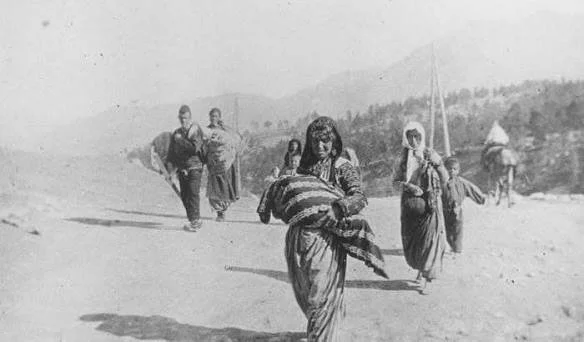
Part of my urgency in writing A Week in Berlin came from the painful truth that the Armenian Genocide remains underrepresented in history books, classrooms, and public discourse. Despite the fact that it is one of the 20th century’s first genocides, it is often footnoted, minimized, or denied outright. Many people I meet know little, if anything, about it. That silence is political, cultural, and ongoing, and like countless descendants of survivors, that erasure can feel personal.
Through fiction, I wanted to resist that erasure. I wanted to create a story that brings the Armenian experience into conversation with broader themes of historical trauma, displacement, and memory. In doing so, I hope not only to honor those who were lost, but also to insist that their stories belong in the world’s collective consciousness.
The Themes the Novel Covers

At its core, A Week in Berlin explores themes of time, memory, identity, and trauma that lives through time. Time, in the novel, is not linear – it folds, breaks, and repeats, much like memory itself. The past is never fully in the past; it interrupts the present and demands to be acknowledged.
Memory functions both as a burden and a bridge, particularly for survivors (and their descendants), whose memories are embodied and shape their identity in ways that are both visible and invisible. Identity, then, becomes a question:
Who are we, if part of our history has been silenced, and what does it mean to belong to a lineage marked by both survival and loss?
And trauma – perhaps the heaviest theme – moves through time like an unrelenting current. Yet, alongside it, there is love, resilience, and the possibility of healing. My novel does not shy away from pain, but it also insists on hope.